Best Influencer Marketing Software in 2026: MyWall vs GRIN vs CreatorIQ vs Modash vs Upfluence
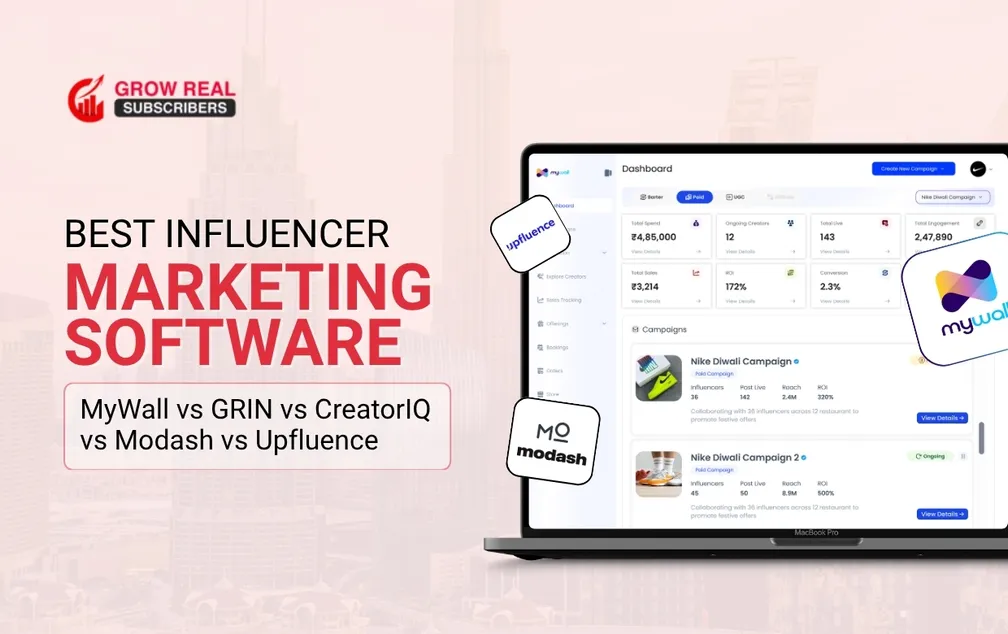
Influencer marketing has become one of the fastest-growing customer acquisition channels brands have, and the days of running it through spreadsheets and email threads are mostly over. Once a creator program grows past a handful of partnerships, brands need software to handle discovery, outreach, content tracking, and reporting without someone manually holding it all together. Choosing the right influencer marketing software shapes campaign efficiency, creator relationships, and how confidently you can report ROI.
This guide compares five platforms brands are evaluating in 2026: MyWall, GRIN, CreatorIQ, Modash, and Upfluence. Each takes a different approach — some built for enterprise scale, others for lean ecommerce teams — so the goal here is fit, not a single winner.
- What Is Influencer Marketing Software?
- Why Brands Need Influencer Marketing Software in 2026
- Quick Comparison Table: Top Influencer Marketing Software
- Detailed List of Influencer Marketing Platforms in 2026
- Feature Comparison: MyWall vs GRIN vs CreatorIQ vs Modash vs Upfluence
- Pricing Comparison of the Best Influencer Marketing Software
- Which Platform Is Best for You?
- Why Growing Brands Are Choosing MyWall
- Buying Guide: How to Choose the Right Influencer Marketing Software
- Conclusion
What Is Influencer Marketing Software?
Influencer marketing software centralizes creator discovery, outreach, campaign management, analytics, payments, and reporting in one system, instead of scattered emails, DMs, and spreadsheets. That's different from an agency, which runs campaigns for you, usually at a markup and with less real-time visibility — software keeps your team in direct control while removing the manual, error-prone parts of the process.
The problems it solves are practical: no more guessing at audience quality by eye, no more chasing a spreadsheet update to find out if a creator shipped their content, and no more compiling ROI numbers by hand at the end of a campaign.
Why Brands Need Influencer Marketing Software in 2026
Influencer marketing spend crossed roughly $32.5 billion in 2025 and is set to pass $40 billion in 2026, and brands now earn close to $5.78 for every dollar spent on creator campaigns. But more brands chasing that growth means more competition for the same good creators — and the brand that replies fastest and looks most organized usually wins the partnership.
That's exactly where spreadsheets and email threads fall short. A slow reply loses a creator to a faster competitor. A missing history means starting from scratch with a creator you've worked with before. And when finance asks what a campaign actually returned, "we think it went well" isn't an answer.
Software fixes these everyday problems directly:
- Slow replies lose creators. Automated outreach means you respond in hours, not days.
- No creator history means starting over every time. A real CRM remembers every past creator relationship, so good partnerships continue instead of starting over.
- Likes and comments don't prove ROI. Sales-tied analytics give you a real number, not just likes and comments, when someone asks about ROI.
- Disconnected teams cause mistakes. Marketing, creative, and finance all see the same live data instead of outdated spreadsheets.
- Growth breaks manual systems. A platform builtto scale handles 5 creators or 500 without needing to be replaced halfway through
Quick Comparison Table: Top Influencer Marketing Software
| Platform | Best For | Influencer Discovery | Campaign Management | Creator CRM | Analytics | AI Features | Pricing Model | Free Trial |
|---|---|---|---|---|---|---|---|---|
| MyWall | Brands/agencies running barter, paid, UGC & affiliate together | Strong (300M+) | Strong | Strong | Strong | Strong (Genie, AI Executives) | Custom quote | Demo-based |
| GRIN | Established DTC/ecommerce brands at scale | Strong | Strong | Strong | Strong (revenue-linked) | Moderate (AI discovery assistant) | Custom quote (~$25K+/yr reported) | Yes (free trial tier) |
| CreatorIQ | Fortune 500 enterprises and global agencies | Strong (20M+) | Strong | Strong | Strong (EMV, benchmarking) | Strong (Creator Graph) | Custom quote (~$30K+/yr reported) | Demo-based |
| Modash | Shopify DTC brands prioritizing discovery | Strong (350M+) | Moderate | Moderate | Moderate | Moderate | Published ($199–$499/mo) | 14 days |
| Upfluence | DTC brands mining their own customer base | Strong (9–12M+) | Strong | Strong | Strong | Strong (Jaice, Live Capture) | Custom quote (~$478–$3,500+/mo reported) | Demo-based |
Detailed List of Influencer Marketing Platforms in 2026
1. MyWall
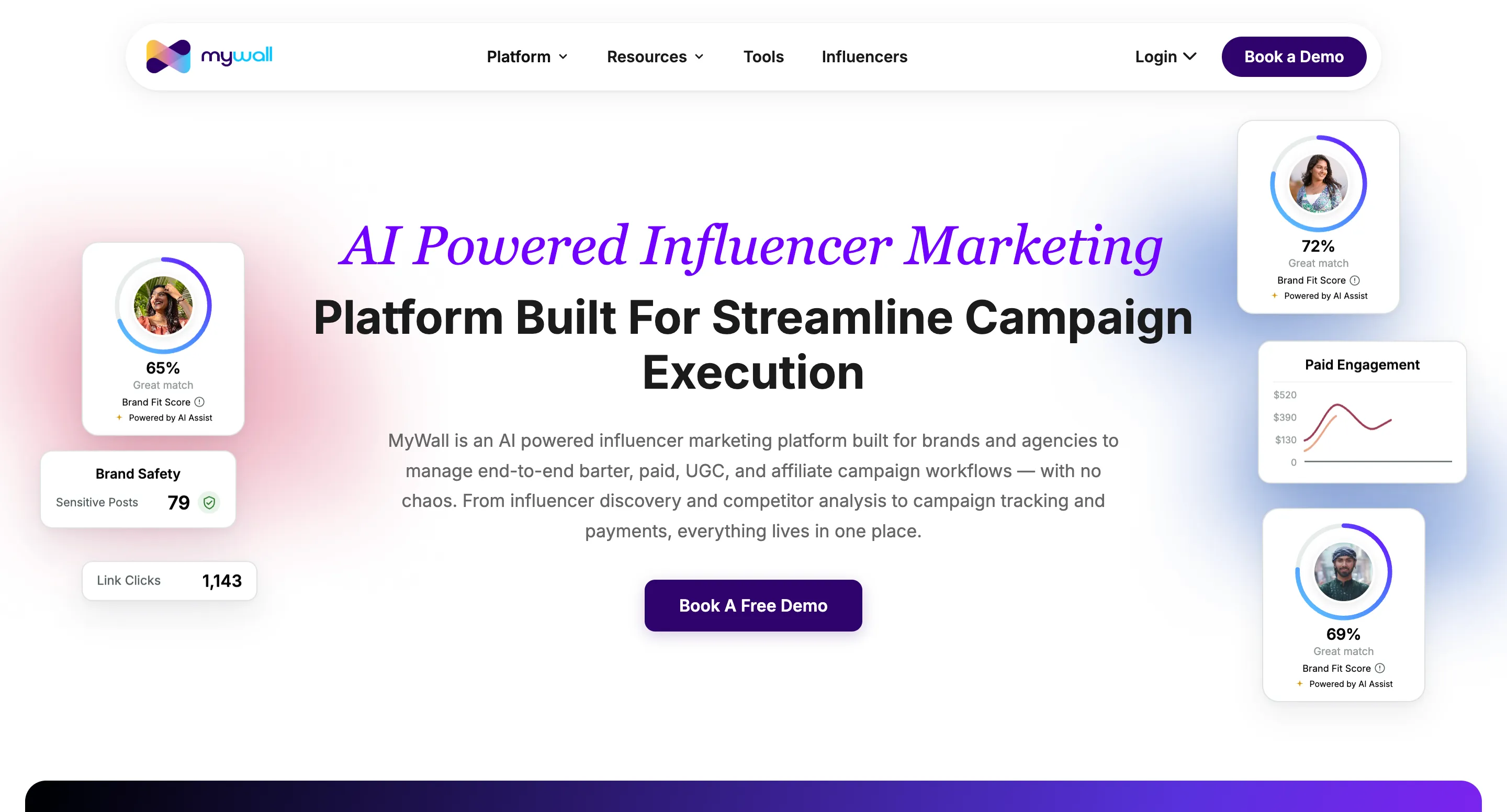
Businesses looking for modern influencer marketing software often need more than creator discovery. They need a platform that centralizes campaign management, competitor research, creator relationships, outreach automation, reporting, and ROI tracking. MyWall combines all of these capabilities into one AI-powered influencer marketing platform built for brands and agencies that want to scale influencer marketing efficiently.
Creator Discovery — find fit, not just followers.
Search across 300M+ profiles on Instagram, TikTok, and YouTube using filters for niche, location, engagement score, and visual score, backed by live, verified performance data instead of self-reported follower counts. It's built to surface the creator whose audience actually overlaps with your customers, not just the one with the biggest number attached.
MyWall Genie — see what's already working before you spend a dollar.
MyWall Genie is an AI-powered competitive intelligence tool that helps brands make smarter influencer marketing decisions with real campaign data. Instead of simply discovering creators, it reveals which influencers competitors are collaborating with, how their sponsored, affiliate, brand collaboration, and UGC campaigns are performing, and the content formats driving the highest engagement in your industry.
Using advanced AI filters, brands can explore creator partnerships by niche, hashtags, captions, audience size, engagement rate, company size, and campaign type. By combining competitor insights with creator discovery, MyWall Genie helps marketers identify proven collaboration opportunities, benchmark campaign performance, and build data-driven influencer marketing strategies with confidence.
AI Executives — a campaign team that runs itself.
From a single prompt, AI Executives set up a campaign, shortlist matching creators, launch outreach, and chase follow-ups automatically, so a coordinator isn't spending a full week on tasks a system can handle in minutes. Humans still approve the decisions that matter; the busywork just disappears.
Built-in CRM — relationships that compound.
Every conversation, collaboration note, and past campaign result stays attached to the creator's profile, so a strong partnership six months ago gets prioritized again automatically instead of getting lost when a team member moves on.
Unified execution and payments.
Product seeding, affiliate tracking, and campaign approvals run through the same dashboard, with real-time analytics tied to actual sales via Shopify, WooCommerce, and Magento integrations, and wallet-based payments that replace one-invoice-at-a-time reimbursement.
Strengths: genuinely end-to-end across campaign types; competitor intelligence most tools lack. Best for: brands and agencies managing multiple campaign types together, from growing ecommerce brands through enterprise.
2. GRIN
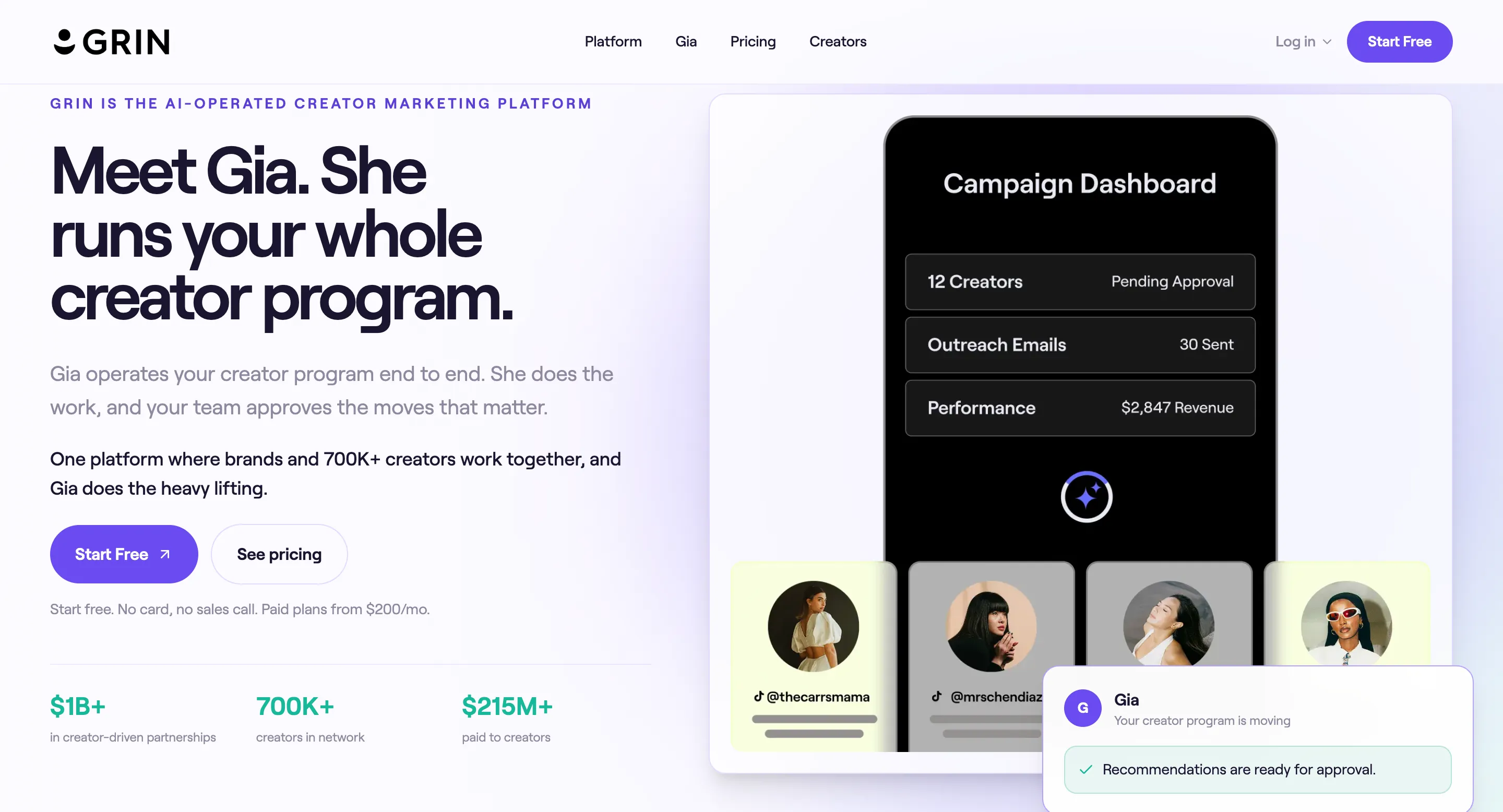
GRIN is an all-in-one creator management platform built for ecommerce and DTC brands, with deep Shopify integration tying influencer activity directly to revenue. Its AI assistant, Gia, surfaces creator recommendations and drafts outreach, covering messaging, shipping, payments, affiliates, and reporting in one dashboard.
Strengths: strong e-commerce integrations; end-to-end for DTC workflows; responsive support per user reviews. Limitations: pricing is high (reportedly starting around $25,000/year with an annual contract), there's a learning curve, and some users say the discovery database needs extra vetting. Best for: established DTC brands running always-on programs at scale.
3. CreatorIQ
CreatorIQ is an enterprise creator marketing platform trusted by Fortune 500 brands like Disney, Sephora, and Unilever, built around an AI-powered discovery and intelligence layer called the Creator Graph. It covers global campaign management, compliance and brand-safety tooling (SafeIQ), and earned media value tracking, with a database of 20M+ creator profiles.
Strengths: genuine enterprise depth — governance, multi-region collaboration, and reporting built for large, distributed teams. Limitations: quote-only pricing reportedly starting around $30,000/year with a required annual contract, pricing out most DTC and mid-market brands; some users note a dense interface. Best for: large enterprises and global agencies with seven-figure influencer budgets.
4. Modash
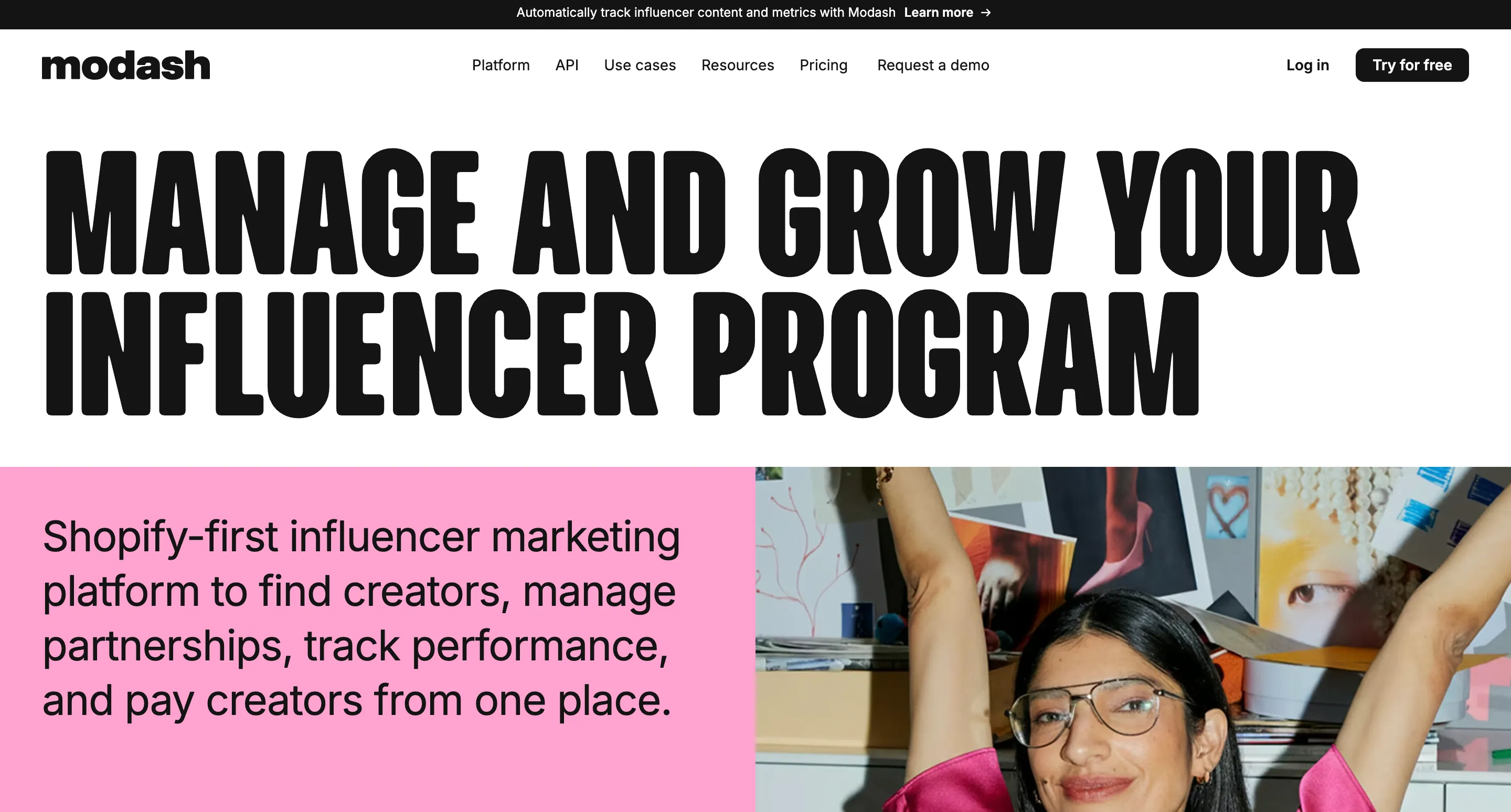
Modash is a discovery-first platform built for Shopify-connected ecommerce brands, known for its 350M+ creator database and unusually transparent, published pricing. It combines search and audience-quality analysis with gifting and promo-code management.
Strengths: published pricing (a rarity here); large, frequently updated database; strong Shopify-native gifting. Considerations: built primarily around Shopify, with less value elsewhere. Best for: Shopify DTC brands running high-volume micro-influencer discovery and gifting.
5. Upfluence
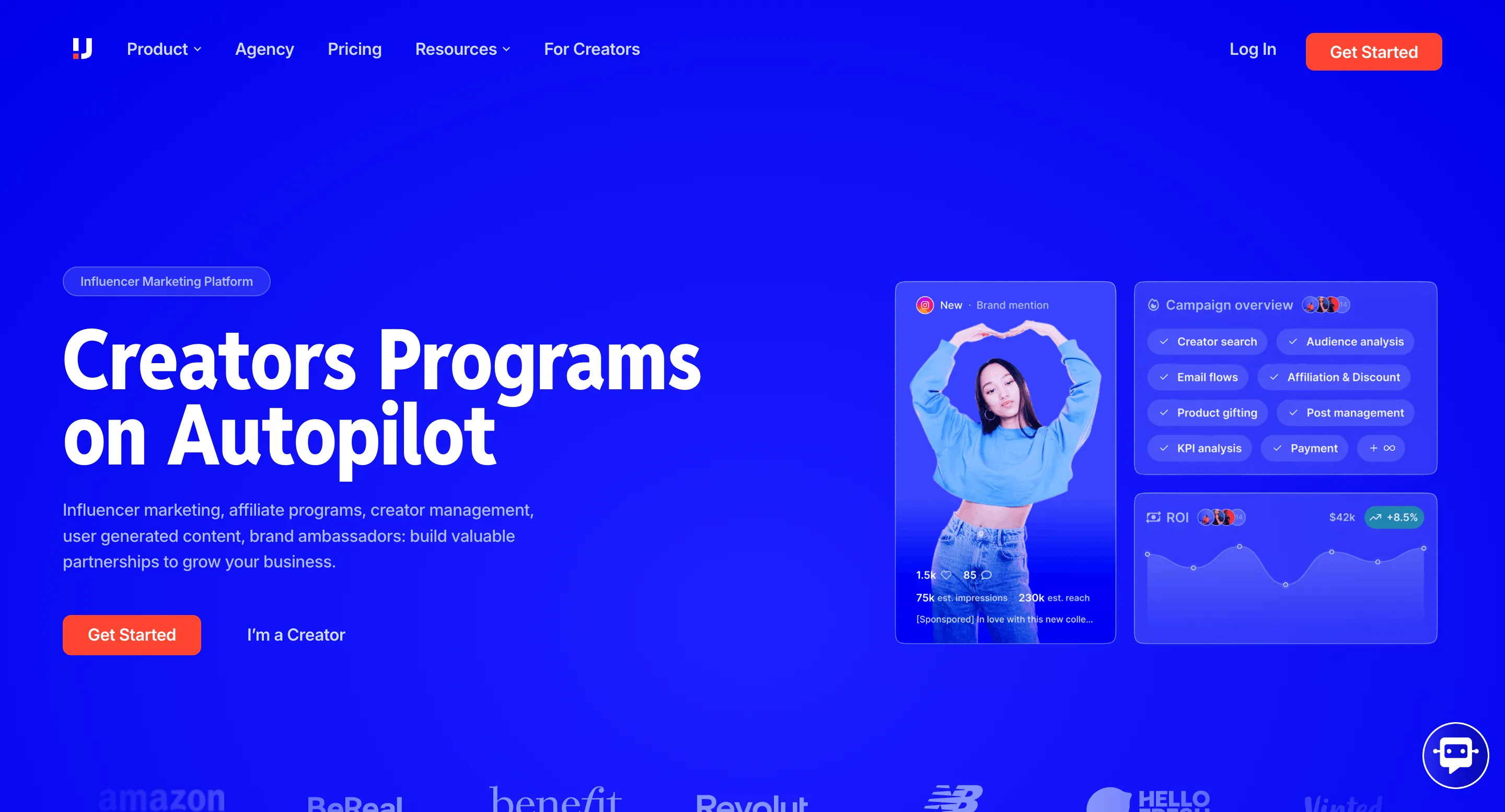
Upfluence is built around Live Capture — identifying influential creators already inside your own website traffic and customer data — alongside a broader 9M–12M+ profile database and an AI co-pilot called Jaice. It offers deep ecommerce integrations and native affiliate and discount-code tracking through Upfluence Pay.
Strengths: a genuinely distinctive discovery model most competitors don't replicate; strong ecommerce integration depth. Considerations: pricing is quote-based, with public estimates ranging roughly from $478 to $3,500+ per month, and contracts typically run 12 months. Best for: mid-market to enterprise DTC brands wanting to convert existing customers into creators.
Feature Comparison: MyWall vs GRIN vs CreatorIQ vs Modash vs Upfluence
| Feature | MyWall | GRIN | CreatorIQ | Modash | Upfluence |
|---|---|---|---|---|---|
| Creator Discovery | Yes (300M+ profiles) | Yes | Yes (20M+ profiles) | Yes (350M+ profiles) | Yes (9–12M+ profiles) |
| AI Capabilities | Genie (competitor intel) + AI Executives (autonomous outreach & follow-ups) | Partial — AI discovery assistant (Gia) | Creator Graph for discovery; outreach itself largely manual | Partial — AI-assisted matching | Yes — Jaice AI co-pilot |
| Campaign Management | Full lifecycle: setup, shortlisting, outreach, approvals in one dashboard | Full lifecycle with Shopify-tied workflows | Full lifecycle but 2–4 week onboarding reported | Lighter; discovery/gifting-focused | Full lifecycle with strong ecommerce-specific workflows |
| Outreach Automation | Automated end-to-end via AI Executives | Automated sequences | Present, but reviews say follow-ups/negotiation stay manual | Limited, mostly manual | Present, secondary to Live Capture |
| Creator CRM | Full history auto-attached to profile | Built-in, deal/payment-linked | Built-in with history & payments | Basic contact management | Full CRM with payment history |
| Product Seeding | Native, run through the same dashboard as paid/affiliate/UGC campaigns | Native, deep Shopify sync | Present but secondary to governance/reporting focus | Strong — gifting is one of Modash's core Shopify-native features | Present, secondary to Live Capture/affiliate focus |
| Affiliate Marketing | Native affiliate tracking in the same dashboard as seeding/paid | Native, revenue-linked | Present but not a primary focus area | Shopify promo-code tracking only | Native — Upfluence Pay handles affiliate + discount-code tracking directly |
| Reporting/Analytics | Yes — sales-tied | Strong (revenue-linked) | Yes — EMV-based | Partial | Yes |
| Workflow Automation | End-to-end via AI Executives | Rules-based automation across the campaign pipeline | Strong on approvals, weak on outreach | Limited — mainly discovery/gifting automation | Present across outreach, gifting, and affiliate workflows |
| Ecommerce Integrations | Shopify, WooCommerce, Magento | Shopify | Shopify + 11 tools | Shopify-first | Shopify, WooCommerce, Klaviyo |
| Ease of Use | High | Moderate | Moderate | High | Moderate |
| Scalability | Small team to enterprise | Strong at DTC scale | Very strong (100+ creators, multi-region) | Moderate | Strong, mid-market to enterprise |
Pricing Comparison of the Best Influencer Marketing Software
MyWall: Custom pricing available upon request.
GRIN: Not publicly published; third-party procurement data reports contracts starting around $25,000/year.
CreatorIQ: Not publicly published; third-party procurement data reports contracts starting around $30,000/year, with no monthly plans.
Modash: Published — Essentials from $199/month (annual), Performance from $499/month (annual); Enterprise is custom pricing available upon request.
Upfluence: Not publicly published; public estimates suggest annual licenses commonly range from roughly $478 to $3,500+ per month.
Which Platform Is Best for You?
| Business Type | Recommended Platform(s) | Why |
|---|---|---|
| Startups | Modash | Published pricing, 14-day trial, low commitment |
| Small businesses | Modash, MyWall | Transparent cost or flexible campaign types without enterprise overhead |
| Ecommerce brands | Modash, GRIN | Deep Shopify-native gifting and revenue tracking |
| DTC brands | Upfluence, MyWall | Customer-to-creator discovery or mixed barter/affiliate support |
| Marketing agencies | MyWall | Multi-client campaign separation and competitive intelligence |
| Enterprise businesses | CreatorIQ | Governance, compliance, and global-scale reporting |
| Global brands | CreatorIQ, MyWall | Multi-region database coverage and structured workflows |
Why Growing Brands Are Choosing MyWall
Most platforms in this comparison do one or two things very well and leave the rest to other tools — GRIN for DTC ecommerce depth, CreatorIQ for enterprise governance, Modash for Shopify-native discovery, Upfluence for customer-to-creator matching. MyWall's approach is to bring creator discovery, campaign execution automation, CRM, analytics, and payments together in one platform.
MyWall supports every major influencer collaboration model—including barter, paid, affiliate, and UGC campaigns—allowing brands to manage creator partnerships from discovery to reporting within a single platform. If you're deciding between collaboration models, explore our guide on Barter vs Paid Collaborations to understand which approach aligns best with your campaign goals.
MyWall Genie gives teams competitor intelligence so strategy is based on evidence instead of instinct. It allows brands to take a complete overview of their competitor's influencer campaigns, such as content inspiration, finding competitors' winning creators, and AI Executives automate campaign setup, creator shortlisting, and outreach follow-ups, cutting hours of manual coordination. Advanced creator discovery across 300M+ profiles pairs with a built-in CRM, so relationships carry over between campaigns, and campaign tracking, product seeding, and affiliate management run through the same dashboard with real-time, sales-tied analytics.
For brands that have outgrown spreadsheets but aren't yet at the enterprise budget tier CreatorIQ or GRIN require, having discovery, execution, and reporting in one connected workflow tends to save meaningfully more time than any single feature would alone.
Buying Guide: How to Choose the Right Influencer Marketing Software
- Budget — published pricing (Modash) simplifies budgeting; custom-quoted platforms require a sales call.
- Team size — confirm per-seat vs. unlimited pricing.
- Creator volume — check usage caps against your real monthly volume.
- AI requirements — ask for a concrete example of what the AI actually automates.
- Campaign complexity — confirm native support if you run barter, paid, UGC, and affiliate together.
- Reporting needs — prioritize sales-tied data over engagement-only metrics.
- Integration requirements — confirm compatibility with your actual ecommerce stack.
- Scalability — check whether the platform still works at 10x your current volume.
- Ease of onboarding — ask about typical onboarding timelines.
- Customer support — response times vary significantly across vendors.
Conclusion
There isn't a single influencer marketing software that's perfect for every business. CreatorIQ is well suited for enterprise organizations, GRIN is a strong choice for ecommerce brands, Modash excels in creator discovery, and Upfluence is ideal for affiliate-driven influencer marketing. If you're looking for an AI-powered influencer marketing platform that combines advanced creator discovery, competitive intelligence, campaign automation, and performance tracking in one place, MyWall offers a complete solution for brands and agencies ready to scale smarter influencer campaigns.